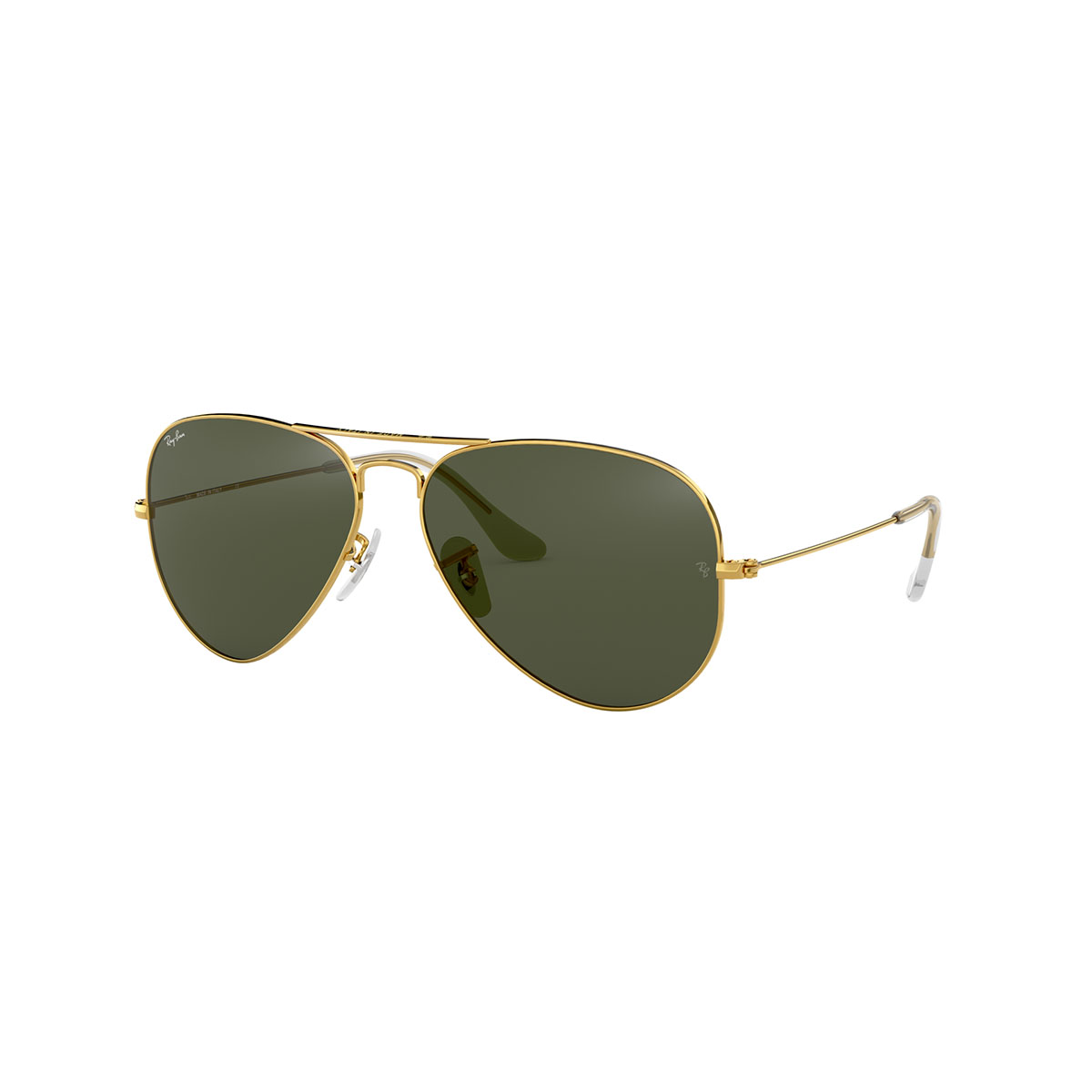
When people say Ray-Ban Aviator, they nearly always mean the RB3025: the metal pilot frame with teardrop lenses and a double bar across the top. Choosing one comes down to the size, the lens and the frame colour. Get the first two right and the colour is simply taste.
At the time of writing we stock the RB3025 in size 58, in seven colourways priced from R2,049 to R3,290. This guide goes through what separates them.
The three sizes: 55, 58 and 62
Ray-Ban makes the RB3025 in three lens widths, 55, 58 and 62 mm, and all three sit on the same 14 mm bridge. The nose fit barely changes between them. What changes is how far the lenses reach across your face.
- 55: the smaller fit, for narrow faces.
- 58: the standard size, and the one we stock. Our listings measure it at 58 mm lens width, 14 mm bridge and 135 mm temple.
- 62: the large fit, for broad faces, or for anyone who finds the 58 sits inside their cheekbones.
Because a frame has two lenses, each 3 mm step in lens width adds about 6 mm to the overall width. That is more than it sounds on a face.
The quickest way to decide is to check a pair you already like. If its lens width is between 56 and 60 mm, the 58 is your size. Our Ray-Ban size guide explains where those numbers are printed and what each one means, and Ray-Ban’s own size guide defines frame size the same way: lens width, then bridge width, in millimetres.
The lenses: G-15, polarised or gradient
G-15 green is the classic Ray-Ban lens, named for the roughly 15% of visible light it lets through. It dims the scene evenly, keeps colours natural and is dark enough for a clear Highveld afternoon. The gold RB3025 L0205 with G-15 lenses is our lowest-priced Aviator at R2,049.
sunglasses/polarized/" class="autolink">Polarised G-15 keeps the same green tint and adds a filter that removes reflected glare off tar, water and car bonnets. We have it with a gunmetal frame, the 004/58 at R3,099, and with a polished black frame, the 002/58 at R3,290. The 002/58 listing gives the lens material as crystal, which is Ray-Ban’s term for glass.
Gradient lenses are darker at the top and lighter at the bottom. They shade the sky while leaving your dashboard and phone easy to read. The silver 003/3F with a light blue gradient costs R2,670.
Between those sit the rose gold frames with blue or green lenses, from R2,489, and a bronze-copper version at R2,427.
Polarised or not, for South African driving
If you commute on the N1 or the N3, most of the glare you fight comes off the road surface and the car ahead. That reflected light is exactly what a polarising filter removes, which is why the extra R1,050 between the L0205 and the 004/58 makes sense for someone who drives every day.
Low sun straight through the windscreen is a different problem. No lens removes the sun itself, and at seven in the morning the visor does more than any filter. Polarised lenses can also black out some phone screens, car displays and ATM screens at certain angles, and tilting your head brings them back.
If you mostly wear sunglasses walking around town and on weekends, the G-15 at R2,049 does the job. The ultraviolet protection is the same on the polarised and the plain versions.
Living with a metal Aviator
- The nose pads adjust. They sit on thin metal arms, so an optometrist can bend them to seat the frame higher or lower on your nose.
- Metal gets hot. A metal frame left on the dashboard in December will be too hot to put on. Keep it in the case, out of the sun.
- The temples are thin. They bend if you sit on them or pull the frame off with one hand, so use both hands and the case.
If the Aviator does not suit you
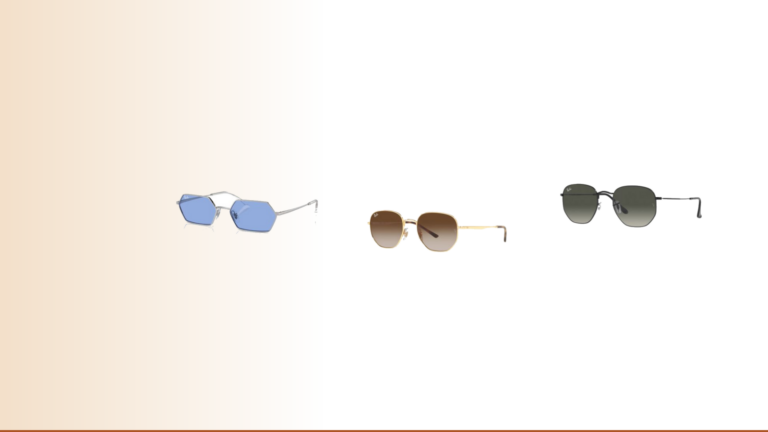
The teardrop lens is deep, about 50 mm top to bottom on the 58, and on a shorter face it can rest on the cheeks. If that happens, look at shallower metal frames. The Round Metal RB3447 has a 46.9 mm lens and starts at R2,097, and the Hexagonal RB3548N has a 44.7 mm lens and starts at R2,279.
If the budget is R349 rather than R2,049, the Move MVS230 is a polarised aviator shape at a fraction of the price. It is not a Ray-Ban and does not pretend to be, but it gets the shape and the glare control right.
How we’d choose
- First pair, mostly town and weekends: the RB3025 L0205 with G-15 lenses, size 58, at R2,049.
- You drive every day: the polarised 004/58 at R3,099.
- You want a lighter lens for mixed light: the gradient 003/3F at R2,670.
- Narrow or broad face: measure a pair you own first. We stock the 58 only at the time of writing, so WhatsApp us on 074 669 3111 before ordering if you think you need the 55 or the 62.
Our Ray-Ban price guide sets the Aviator against every other Ray-Ban model we stock.
Frequently asked questions
What size Ray-Ban Aviator should I get?
The 58 is the standard RB3025 size and the one we stock. If a pair that fits you has a lens width of 55 mm or less, look at the 55; if it is 61 mm or more, the 62. All three sizes use a 14 mm bridge.
Are polarised Aviators worth the extra money?
If you drive a lot or spend time near water, yes, because the polarised RB3025 cuts the glare that bounces off tar and water. The UV protection is the same on both, so if you mostly wear them in town, the R2,049 G-15 version is enough.
What does L0205 or 002/58 mean on an RB3025?
It is the colour code. L0205 is a gold frame with green G-15 lenses, 002/58 is a black frame with polarised G-15 lenses, and 004/58 is a gunmetal frame with polarised G-15 lenses.