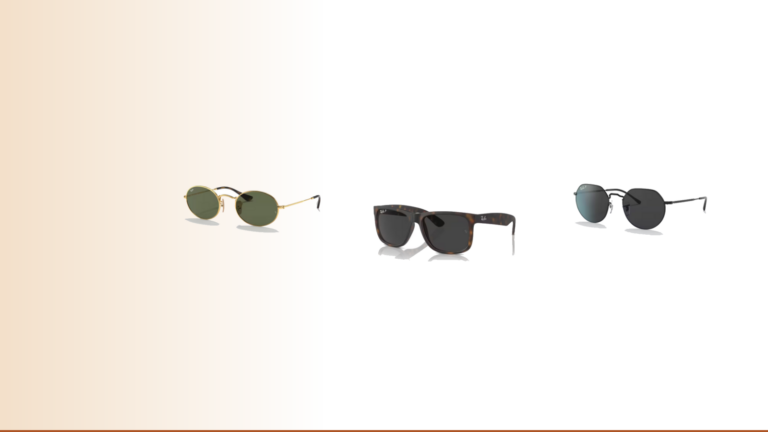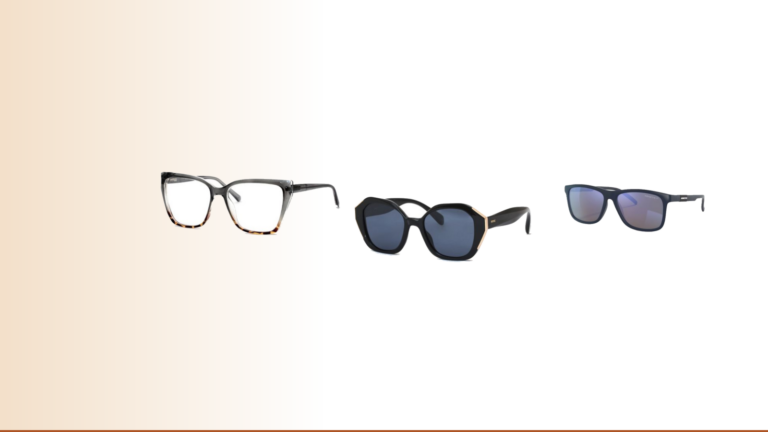

You do not need to spend R2,000 to get sunglasses/polarized/" class="autolink">polarised lenses. At the time of writing, 43 of the polarised frames in our range cost R349 or less, all of them from Move, and a polarised Vogue costs R999.
Above R1,000 you pay for the brand, the frame materials, lens technology such as Ray-Ban’s G-15 and Oakley’s Prizm, and the finish. Below it, you still get the part that does the work on glare: a polarising filter. This guide covers what that filter does, how to check it, and which pairs we would pick.
What a polarised lens does
Sunlight bouncing off a flat surface such as tar, water or a car bonnet becomes horizontally polarised, which is what you see as glare. A polarised lens contains a filter that blocks light vibrating in that direction, so the glare drops out while the rest of the scene stays visible.
It does not make a lens darker, and it does not add ultraviolet protection. Those are separate properties of the lens, which our explainer on polarised versus UV protection covers in full.
Where it earns its money in South Africa
On the road. Low sun on the N1 or the N3 early in the morning or late in the afternoon bounces off the tar and the back window of the car in front. After a Highveld thunderstorm, a wet road turns into a mirror. That reflected light is exactly what a polarised lens removes.
On the water. At Hartbeespoort, the Vaal or the coast, polarisation cuts the surface glare and lets you see into the water instead of off it.
At the beach. The glare comes off the wet sand and the sea, and so does extra ultraviolet. The World Health Organization notes that sand reflects about 15% of UV and sea foam about 25%, which is why UV protection matters as much as polarisation there.
Up on the Highveld. The same WHO page puts the increase in UV at about 10% for every 1,000 m of altitude, and Johannesburg sits around 1,750 m. Every polarised pair we sell also carries UVA and UVB protection, and that part is not optional.
Where polarisation gets in the way
Many phone screens, car displays and ATM screens give off polarised light of their own. Through a polarised lens they can dim or black out at certain angles, and tilting your head brings them back. It is normal, and it does not mean the lens is faulty.
Polarised lenses are also no help at night. Any tinted lens cuts light you need in the dark, so take them off when the sun goes down.
How to check that a lens is polarised
Hold the sunglasses in front of a phone or laptop screen showing something white. Rotate them slowly through a quarter turn. A polarised lens goes noticeably darker at one angle; an ordinary tinted lens stays the same.
You can do the same test outside. Look at the glare on a car bonnet with the sunglasses on, then tilt your head sideways. With polarised lenses the glare is weakest while your head is level and comes back as you tilt.
What R329 to R349 gets you from Move
Move is the largest part of our polarised range, at R329 or R349 a pair at the time of writing. Where the Move listings give specifications, they describe frames made from TR90, a light and flexible plastic, with polarised lenses and UVA and UVB protection. Most of the shapes people ask for are covered:
- Aviator: the Move MVS230 at R349.
- Wayfarer-style square: the Move MVS222 at R349.
- Rectangle: the Move MVS226 at R349.
- Women’s frames: the Move MVS187 at R329, plus cat-eye, butterfly and hexagon shapes at R349.
What you give up at this price is the brand lens technology and the finish of a R2,000 frame. What you keep is the glare control. Two Move pairs come to R658 or more, which also clears the R500 line for free standard delivery.
What R999 gets you from Vogue
The Vogue VO5524S is an acetate frame in a soft pillow shape with polarised gradient lenses, for R999. It measures 54 mm across the lens with a 20 mm bridge and 140 mm temples.
One caution if you are shopping by budget: not every frame under R1,000 is polarised. Our Arnette frames at R699 and R999 are not, so check for the word polarised in the listing before you order.
When it is worth spending more
If you wear sunglasses for hours every day, a better-fitting frame can be worth paying for. The Under Armour 0007/G/S at R1,499 is polarised and listed as blocking 100% of UVA, UVB and UVC. Our lowest-priced polarised Oakley starts at R2,100 and our lowest-priced polarised Ray-Ban at R2,350, where you add brand lenses and, on metal frames like the Aviator, adjustable nose pads.
How we’d choose
- Daily driving on a budget: a Move square or rectangle frame at R349.
- Water and beach days: a larger Move frame that covers more of the eye, and rinse it in fresh water afterwards.
- Style first, under R1,000: the Vogue VO5524S at R999.
- Hours behind the wheel every day: consider the Under Armour at R1,499 or a polarised Ray-Ban from R2,350.
Sand and salt are hard on lenses, whatever they cost. After a windy day at Blouberg or a humid one in Durban, rinse the lenses under the tap before you wipe them, because dry-wiping grinds grit into the surface.
Frequently asked questions
Are cheap polarised sunglasses really polarised?
Some are not, so test them. Hold the lens in front of a phone or laptop screen and rotate it through a quarter turn: a polarised lens goes darker at one angle, and a plain tinted lens does not.
Do polarised sunglasses protect against UV?
Polarisation handles glare, not ultraviolet. UV protection comes from the lens itself, so look for UV400 or 100% UVA and UVB protection on the listing, whatever the price.
Can I wear polarised sunglasses for night driving?
No. Any tinted lens cuts the light you need after dark, and polarisation does nothing to help at night. Wear clear lenses or none.